Who does tpot trust? Depends on who you're asking, and what you're asking about.
377 people from a Twitter community called tpot ("this part of Twitter") uploaded their full twitter archives to a public dataset called the Community Archive (8.8 million of their tweets and 21 million of their likes). I'm in the archive too, as @jordanthink.
We applied UpTrust's trust tech on it to ask a bunch of questions like:
- How does "trust" flow in this community? Are there subgroups?
- Who do people argue with (and what does that tell us?)
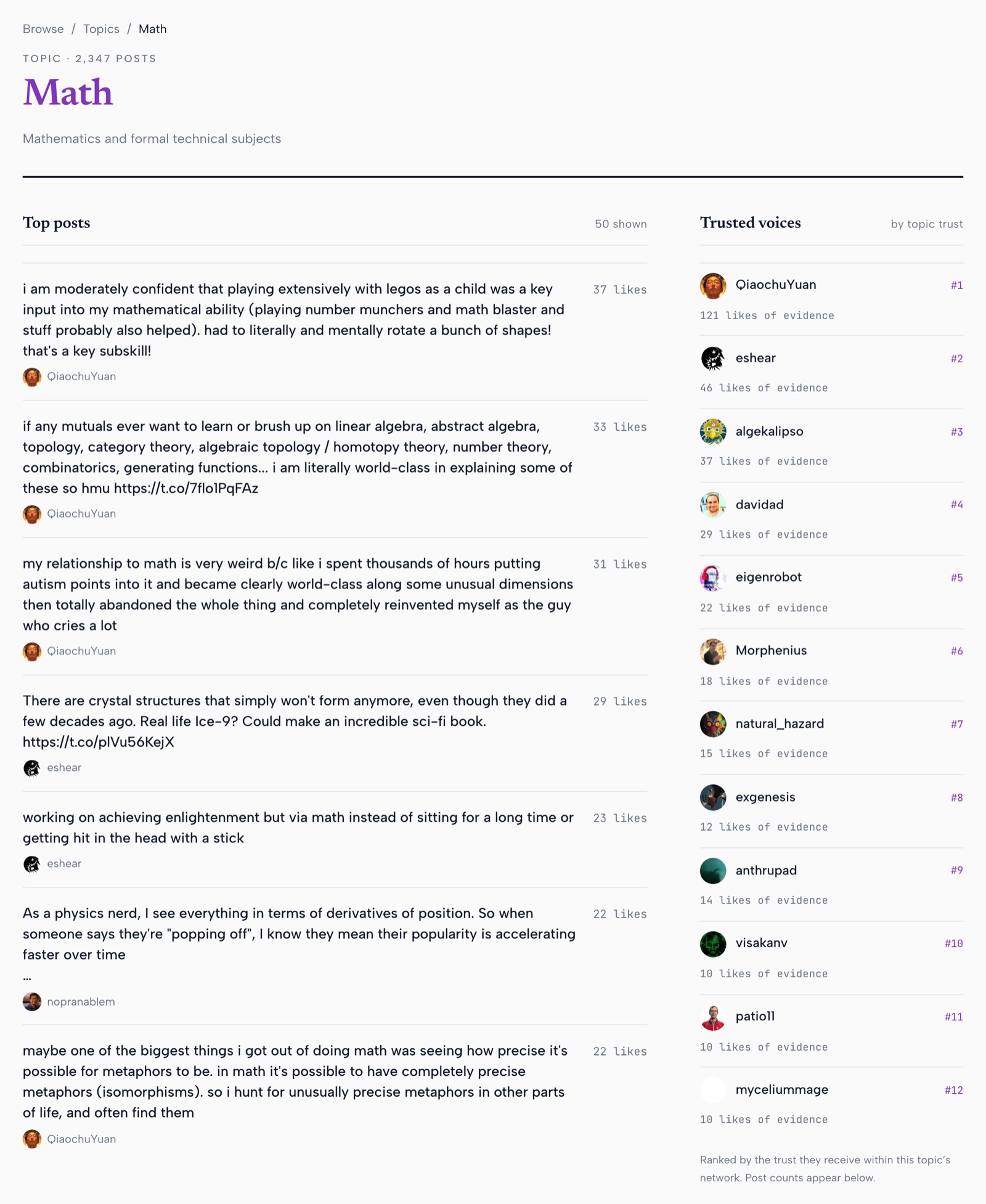
- What happens when we filter trust by topic? Are there different people tpot trusts more for some things and less for others? (yes) If so, who's at the top?
- How tightly coupled are popularity and trust? (depends on the topic)
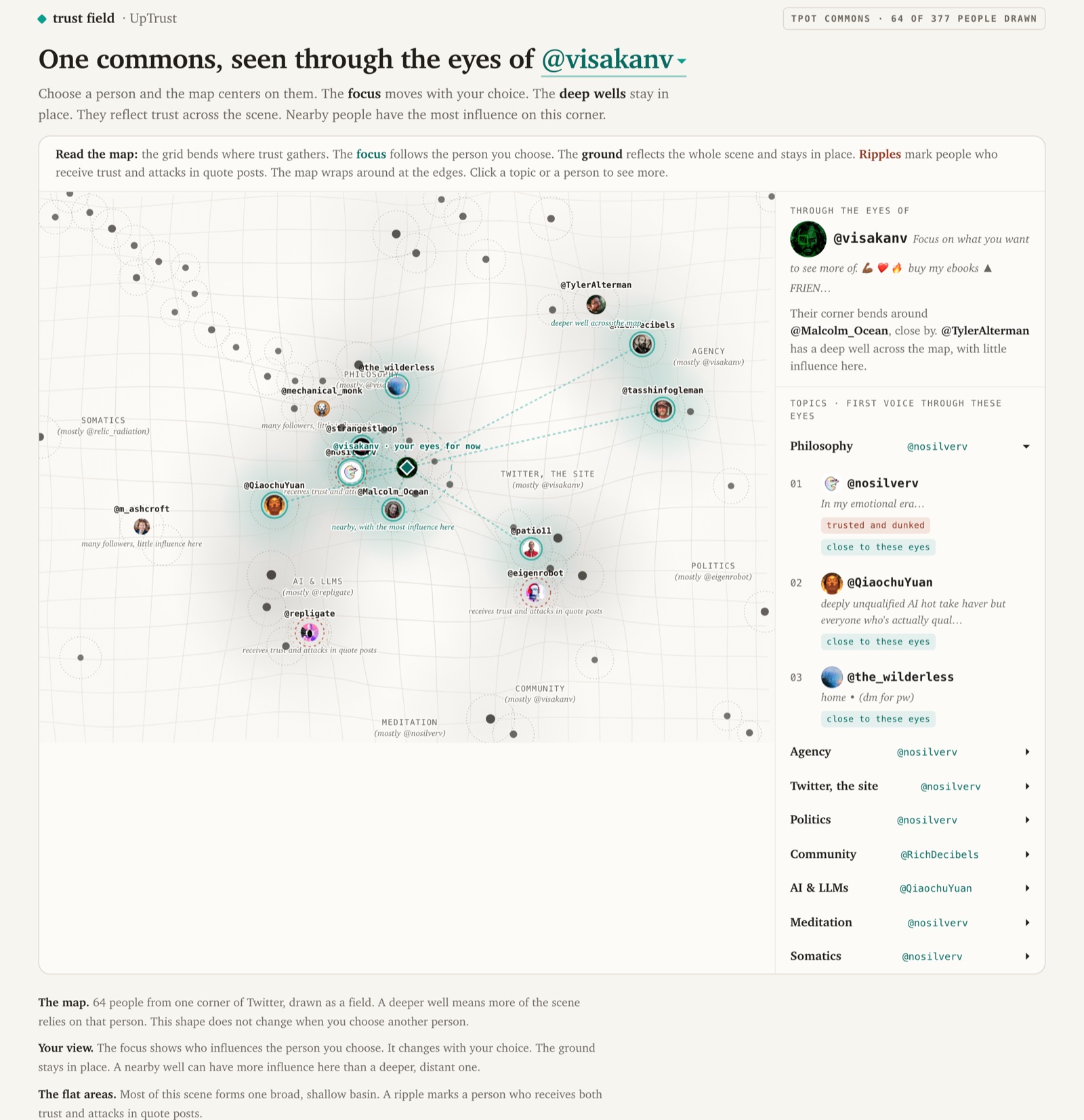
- Does everyone in tpot see the same thing?
Findings, tldr:
- tpot has two circles, and trust between them runs mostly one way.
- The people tpot argues with most are also among the people it trusts most.
- Trust by topic gives 51 leaderboards, and 65 different people show up near the top of them.
- Follower count is a weak guide to trust on personal topics like meditation, music and grief.
- Members see different feeds: 30 different posts come out on top, depending on whose eyes you use.
- None of this removes the question of whose eyes you're looking through.
1. What's the lay of the land here in this part of twitter?
This t-party has two crowds.
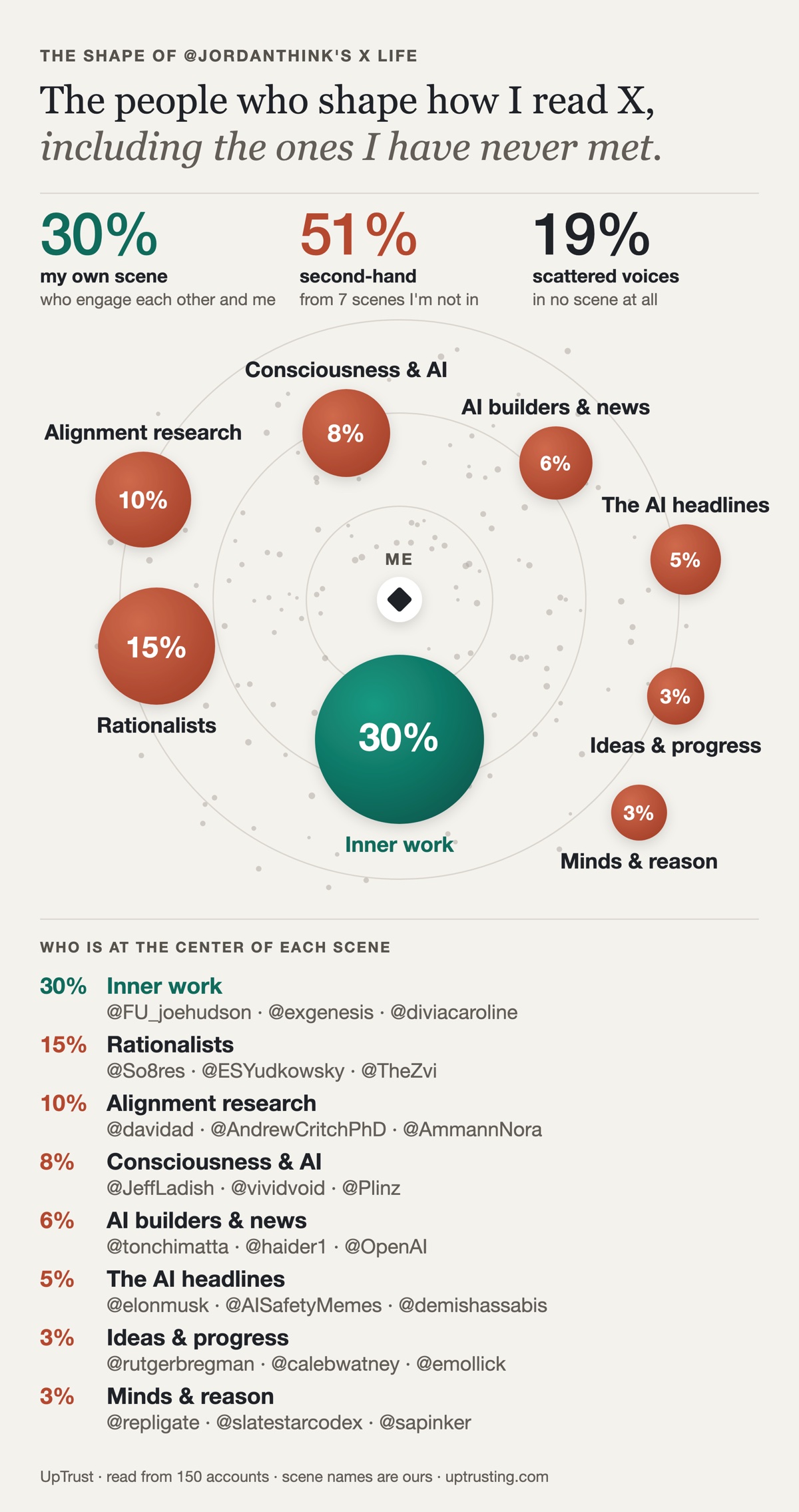
First, we infer trust from interactions like likes, quotes, mentions and retweets, using our algorithm. We start with each person's strongest 15 links, and each time trust flows through someone, it decays (you trust your friend Bobby's friend Carla less than you trust Bobby). Then, we use standard cluster detection methods to find groups of people who trust each other greater than chance, and call those circles. Here's who I interact with on X, for example:
Trust flows in two crowds
Looking at how trust moves, we see two crowds:
The introspection crowd has 253 people. At its center: @visakanv, @nosilverv, @QiaochuYuan, @RichDecibels and @TylerAlterman. Compared with the other circle, its members post about three times as much about friendship, therapy and emotions. They also post more about parenting, relationships and community.
The AI & minds crowd has 97 people. At its center: @repligate, @voooooogel, @eshear, @algekalipso and @davidad. Their posts are about AI far more often: 17% of their topic tags are LLMs and 6.7% are AI safety. In the introspection crowd those figures are 1.3% and 0.5%. The AI & minds crowd also posts more about psychedelics, math and consciousness.
The AI & minds crowd has two sub-groups, which we're calling the model-whisperer crowd (@repligate, @voooooogel, @jd_pressman) and the AI safety crowd (@eshear, @TheZvi, @davidad).
27 members sit in neither; almost all of them have very little activity; twelve have no trust links at all.
Both crowds trust and dunk on their own members more than baseline, but AI & minds trusts across the divide more than introspection does. The introspection crowd likes and trusts the AI & minds crowd much less than its size would predict. A follow-up piece digs into why.1
2. And the Most Contentious Figures Award goes to...
We think distrust is critical for trust networks. How else do we get boundaries, accountability? So we got an LLM to classify all 55,299 quote tweets between tpot members, and found that ~5% of them are adversarial (2,920).2
So who gets dunked on? These five get 44% of distrust links:
- @eigenrobot: dunked on by 20 people, 6th by trust across all of tpot
- @nosilverv: dunked on by 18, 2nd by trust
- @visakanv: dunked on by 17, 1st by trust
- @repligate: dunked on by 12, 21st by trust
- @QiaochuYuan: dunked on by 9, 3rd by trust
Most interesting: the most argued-with people are also (mostly) the most trusted people. This makes sense for an intellectually honest community: you only argue with the people whose views you take seriously.
But it actually is a cool accomplishment: they provoke generative disagreement because they're trusted and iconoclastic.
3. Fifty-one leaderboards: one trust mountain range, many epistemic peaks
Is there anyone you trust "in general," on literally all topics? We see "general trust" as a sometimes-useful but very-lossy abstraction. Trusted about… ? To do what?
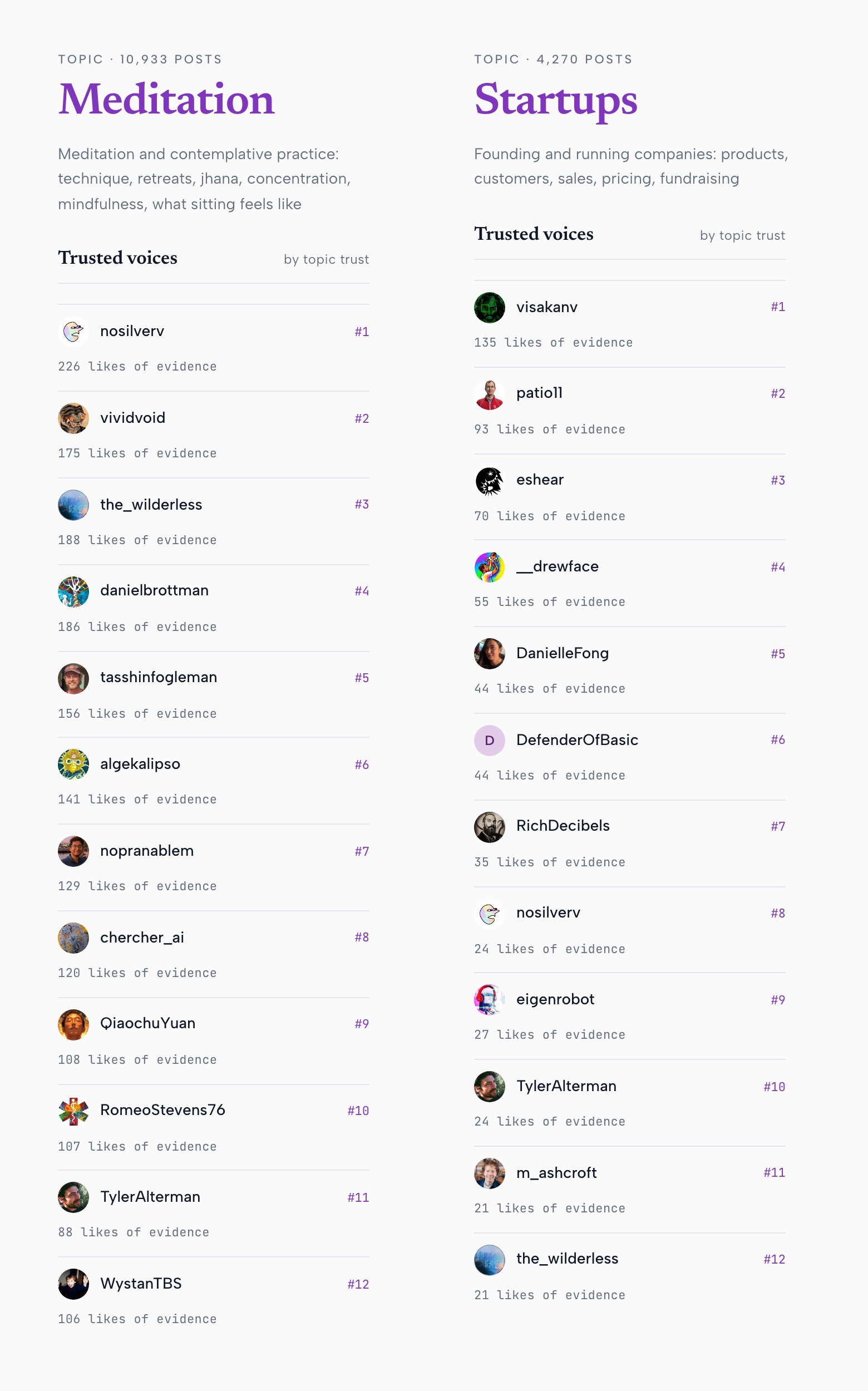
To answer those questions, we tagged 604,904 posts by subject (394,247 got at least one tag), found tpot's 51 most beloved subjects, and ran the trust analysis in each one. If you like a post about meditation, this gives us some information about your endorsement of that person re meditation, but not start-ups; these micro-votes flow through the network like a liquid democracy so the people you trust more on meditations get more say.
Suddenly the single big community becomes a bumpy hill-country with 51 distinct leaderboards. The people tpot trusts about AI safety are not the same people it trusts about parenting.
- Math: tpot trusts @QiaochuYuan twice as much as second place @eshear.
- Startups: @visakanv, @patio11, @eshear.
- Meditation: @nosilverv, @vividvoid, @the_wilderless.
- LLMs: @repligate, @QiaochuYuan, @voooooogel.
The boards are not totally independent. @visakanv leads 26 of the 51. Some of that is sheer volume: he gets more likes than anyone else (11% of all in the community), and he makes the top 12 on 48 of the 51 boards. But after him, there's not much concentration: @eigenrobot, @nosilverv and @QiaochuYuan lead four each, @goblinodds and @the_wilderless lead three each. No one else leads more than two. So the picture is one social center, many epistemic centers, with the social center visible from about half the peaks. Also interesting: below first place, the leaderboards diverge a lot: 65 different people show up somewhere in the top twelve.
Looking at our Most Contentious Figures: being dunked on doesn't cost them their home turf. @nosilverv tops the meditation board. @repligate tops LLMs and AI safety. @eigenrobot tops politics. We humans often disagree hard with someone in many areas and still go to them for advice in the area they know best. It's cool to see that show up in the trust graph, on the open internet.
I started wondering, are these trust leaderboards the same as the circles?
Mostly, with twists. The introspection crowd holds 91% of all top-12 slots, and 48 of the 51 first places. The AI & minds crowd is 28% of the people in a circle but holds 9% of the slots.
On its own subjects, though, the AI & minds crowd leads. It holds 8 of the 12 top slots on LLMs and 9 of 12 on AI safety. @repligate is first on both, and @algekalipso is first on psychedelics.
The introspection crowd is bigger and gave about ten times as many likes. But give both crowds an equal say and it still holds 74% of the slots and 46 of 51 first places. Most of the lead comes from how much it posts (91% of all posts), not how much it likes.
4. How related are popularity and trust?
To compare follower count with topic trust, we line everyone up once by followers and once by trust, and ask how similar the two orderings are, in each topic. The result is a "Spearman rank correlation" where the median is +0.54 across all the topics: related, but not even close to interchangeable.3
The correlation is weakest on the introspection crowd's topics of choice: +0.27 on meditation, +0.30 on music, +0.33 on grief and mortality, and +0.35 on IFS. It's strongest where the AI & minds crowd lives: AI safety, LLMs and epistemics, all about +0.69. Across all 51 topics, the bigger the AI & minds crowd's share of a topic's trust, the more closely trust tracks follower count (ρ = +0.67).
Put simply: on AI, tpot trusts roughly who the internet already knows. On meditation and grief, it trusts people the internet has mostly never heard of.
That isn't one crowd being more famous than the other (same median following), neither is it about sample size (~ same active). Look only inside the introspection crowd and the pattern is still there: its members' trust follows fame on LLMs (+0.70) and much less on meditation (+0.37). So it's the subject.
What that looks like in practice:
- @UntilTrees ranks 141st by followers among people active in music (599 followers), and 34th by trust.
- @brimmingvessel ranks 100th by followers on grief and mortality, and 7th by trust.
- @5matthewdub ranks 96th by followers on psychedelics, and 5th by trust.
- @nowtheo ranks 71st by followers on IFS, and 10th by trust.
Since our topic leaderboards are built from likes on posts about the topic, they track who gets liked on that topic almost perfectly (ρ = .95). What this shows is more interesting imo: a big following gets you more engagement. It does a lot less for you when a community has strong views on who is credible about what.
5. So what? Whose eyes are looking at what?
Does everyone see the same feed?
No. Across members' home feeds, 30 different posts come out on top. For two members picked at random, their top five posts overlap 0.31 on average, on a scale where 0 means nothing in common and 1 means identical. The biggest group of people with the exact same top five is five people. Inside single topics the spread is wider still: a median of 40 different #1 posts per topic board.
There is one shared favorite. @RomeoStevens76's most-liked post is #1 for 230 members, because it's the most-liked member post in the archive (118 members liked it). A trust-weighted feed still shows what nearly everyone agrees on. It just doesn't stop there.
Why this matters
Most recommender systems max their company's metric (usually engagement) by predicting your behavior, which hyperstitiously becomes shaping your behavior ("hyperstition": tpot word for self-fulfilling prophecy). We think hyperstition is unavoidable (and therefore dangerously naive to pretend otherwise), so we ought to use it for good. Specifically, it shapes incentives by designing the system to answer certain questions and not others. If the question a system is answering is "whose judgment is credible to you, about this thing, given the trust structure around you?" then the way to win is to be credible to the people you have access to. This ought to incentivize people to at least appear more trustworthy. Bonus if you make it so over the long run, the cheapest way to appear trustworthy is usually to actually be trustworthy.
Here's what the tpot data shows that isn't obvious:
- A community can be close-knit and still split into circles.
- One circle can mostly ignore another that shares its room.
- Being argued with often goes along with being trusted. (This is helpful for the contested figures to remember, but also in terms of being aware of who we deem trustworthy as a society at large)
- Popularity is a weak guide to who is trusted on some topics.
- A community can have one social center and many centers of expertise. (We don't yet know if tpot is rare or representative in this way)
- Members really do see different things. (Topic trust does give more domain-sensitive recommendations, which probably means they're "better.")
Together, this leads us to…
Trust is relative
UpTrust's premise is that trust is contextual, and that some contexts matter more than others.
This means there is no single answer to the question "how trusted is this person?" Meaning comes from who's doing the trusting, of whom, in what domain and moment in time, embedded in a particular society.
T(viewer, target, domain, time, society)
This creates an abundance of meaningful numbers, where meaning depends on what we want to know. This claim is so obvious it's almost not worth saying, except that people forget it ALL THE TIME. I can't tell you how many times I've pitched UpTrust and people say, "oh great, I can't wait to show my parents why they're wrong," not considering that maybe their parents are right, or at least right about something, relative to some community.
Most of us already do a low-res version of this. Google, Yelp, Amazon and Rotten Tomatoes scores look global at first glance. But we read them with a lot of context. How many reviews are there? Are the reviewers vetted? How many reviews have they written? Some people have rules like: "I trust Rotten Tomatoes when the audience and critic scores are within 10% of each other, the movie isn't political, and it's a genre I like."
Still, each of those sites collapses everything into one score per restaurant, product or movie. That gives bad actors one system to learn to game. As compute gets cheaper, gaming gets easier. We trust those scores less and less, and fall back on our own private context.
The tpot data shows both kinds of relativity. The 51 leaderboards show domain-relativity. The 30 different #1 posts show viewer-relativity.
But the commons is real
Perspective going all the way down does not mean everything is just opinion. Not all contexts are created equally. Some are WAY BETTER for different questions. When enough people trust similarly, there's an outsized impact on the entire trust field.
Metaphorically: how you see a mountain depends on where you're looking from (trust is contextual), but the mountain affects the weather, and your experience of the weather, no matter where you're looking from (some context matters more than others). Eg: no matter how left-wing you are, you can't opt-out of Republicans influencing the field of American politics.
We call these gatherings of trust-mass "communities." Usually they're self-identified, like tpot. We call ideological trust-mass-field-warpers "egregores" and they tend to influence many communities, and tend to be relatively unrecognized (although that's changing). Your view is yours, but the curvature you are moving through was made by everyone together.
Distance matters as much as mass
By "distance" here we mean hops on the trust graph (how many people trust passes through to reach you). You trust your friends a lot. You trust their friends a little less, and friends of friends of friends even less, so a stranger three steps away barely moves your rankings, while someone your tight circle engages daily has a much bigger impact.
By cosmological analogy: what governs your orbit is a combination of the mass and its proximity to you. Here on earth, our tiny sun's gravity affects us a lot, but a supermassive black hole barely matters to us, because it's so far away.
6. Appendix: what we mean by "trust", "community", "dunk" and "topic"
(After this sentence, this part is unapologetically written by an LLM; maybe you're having your LLM explain it to you anyway?)
Trust. We can't observe trust directly on Twitter, so we infer it from repeated social behavior we have access to. Each like, retweet, reply, quote and mention is a noisy signal that we weight as evidence of trust from one person toward another, and every signal fades with a two-year half-life. A supportive quote adds trust; an adversarial one never subtracts it. We're calling the resulting latent variable "trust" because it's the closest normal word to the results we believe the method supports. Trust then flows transitively, but not exactly like PageRank because there is no single global ranking. For each viewer, the engine asks how much that viewer trusts each other member directly, then how much the people they trust vouch for the rest, discounting each hop, until the answer settles. Every member gets their own map. The exact weighting and propagation rules are our engine and stay proprietary for now.
In a community as tightly knit as tpot, letting everyone's full web of engagement flow through the network makes nearly everyone trust nearly everyone. So we keep each person's 15 strongest direct links and let trust flow from there. That keeps each member's map their own. It's a stopgap until the engine handles dense graphs like this one on its own. Either way, the commons is real and unavoidable. All that collective trust mass bends the space every member moves through, and it bends it categorically more than any single viewer does. You can think of it as a field with real shape.
Community. We run community detection (Louvain) on the strongest half of the trust edges. The two crowds show up at every cut from all the edges down to the strongest 30%, at roughly the same sizes (259/107 with every edge, 253/97 at half). Keep only the top 20% and the introspection crowd splits in two. At 10% the AI & minds crowd disappears, and at 5% one circle is left. The two sub-groups come from running Louvain again inside the AI & minds crowd. Treat the circles as one lens rather than the lay of the land. We named the crowds ourselves. Our LLM's first try was "Cream & Disciples."
Dunk. Only quote tweets are classified, by Claude Haiku, as supportive, neutral or adversarial. A dunk only counts as distrust when the same person dunks on the same target at least twice, and the classifier is confident (0.8 or higher) both times. That keeps one-off jokes and playful negging out. After the filter, 173 repeated-dunk relationships remain: 74 people dunking on 63 others. Dunks fade with the same two-year half-life as everything else. Distrust is kept in its own register rather than folded into the trust computation, for two reasons: a fabricated disagreement can never rearrange the map, and "distrusted here, trusted there" only stays visible if the two are kept apart. That is why someone can be both highly trusted and often dunked on. One soft spot we know about: 13 of the 173 relationships clear the repeat guard on two dunks of the same tweet rather than two separate occasions.
Topic. Claude Haiku tagged posts with up to a few of 51 subjects. Topic trust is built from likes only: a like on a post tagged "meditation" is a vote for its author on meditation. Likes are the one signal with clean post-level topic attribution (retweet and reply targets are people, not stored tweets). The general trust map uses all five signals.
Notes
- "Baseline" means what circle size alone predicts: the introspection crowd is 72% of the people in a circle, so if trust ignored circles, 72% of anyone's trust would go there. The introspection crowd gives the AI & minds crowd well under that share on every measure we tried: direct links, the trust the engine computes, likes, and likes weighed against how much each crowd posts. The AI & minds crowd gives the introspection crowd more of its share on each of them, though half of its direct links across land on just ten people. Weighed against post volume the likes gap narrows, since the AI & minds crowd writes only 8.5% of the posts, but it still likes its own posts about four times as often as that share predicts. Distrust stays close to home too: 88% of the introspection crowd's dunks land on its own members, and so do 69% of the AI & minds crowd's (baselines 72% and 28%). Those percentages rest on only 173 distrust links, so read them as a lean, not a law. ↩
- See "Dunk" above. ↩
- For each topic, we rank the members active in it twice: once by follower count (from the archive's account table, pulled 29 September) and once by trust inside the topic. We then take the Spearman correlation of the two rankings. Across the 51 topics it runs from +0.27 (meditation) to +0.69 (AI safety), with a median of +0.54. Topic trust is built from likes on posts about that topic, so it tracks who gets liked on the topic almost perfectly (+0.95). The follower comparison is the one that tells you something new. ↩
Corpus
377 members; 8.76M member tweets; 21.29M likes; 604,904 posts, of which 394,247 carry at least one topic tag; 22,055 trust edges; 55,299 member-to-member quotes classified, 2,920 (5.28%) adversarial; 173 distrust edges (74 people repeatedly dunking on 63 others); 51 topics.
Topic leaderboards
Each entry reads trust mass / people: the summed trust flowing to that person on that topic, and how many members' maps contribute to it.
- math: QiaochuYuan 35.7/145; eshear 16.7/100; algekalipso 12.2/71; davidad 9.4/51; eigenrobot 7.7/50
- ai-safety: repligate 36.4/117; eshear 30.4/138; QiaochuYuan 26.8/119; davidad 25.6/91; eigenrobot 24.0/97
- meditation: nosilverv 56.7/184; vividvoid 46.8/164; the_wilderless 46.0/143; danielbrottman 44.4/139; tasshinfogleman 40.0/132
- ifs: the_wilderless 24.7/104; christineist 21.7/89; visakanv 20.2/105; AskYatharth 17.6/84; RichDecibels 16.4/77
- startups: visakanv 38.8/153; patio11 25.2/92; eshear 23.2/113; __drewface 17.3/94; DanielleFong 15.0/79
- llm: repligate 57.7/171; QiaochuYuan 45.6/171; voooooogel 36.7/121; eshear 35.6/160; eigenrobot 28.8/124
Topics led by mass: visakanv 26; eigenrobot, nosilverv and QiaochuYuan 4 each; the_wilderless and goblinodds 3 each; repligate 2; five others 1 each, of 51 total.
Fame vs trust
Real follower counts from the archive's account table. Per-topic Spearman (followers, in-topic trust) over 51 topics: median +0.54, min +0.27 (meditation), max +0.69 (AI safety).
Lowest-correlation topics and their biggest up-mover (followers rank -> trust rank, followers):
- meditation (n=156, rho +0.27): ulyssepence 144 -> 33 (871 followers)
- music (n=150, rho +0.30): UntilTrees 141 -> 34 (599 followers)
- grief-mortality (n=115, rho +0.33): brimmingvessel 100 -> 7 (1,388 followers)
- ifs (n=112, rho +0.35): UntilTrees 110 -> 26 (599 followers)
- buddhism-awakening (n=135, rho +0.37): UntilTrees 131 -> 48 (599 followers)
- psychedelics (n=122, rho +0.37): ulyssepence 117 -> 24 (871 followers)
The whole article is computed from a September 25th 2026 snapshot. tpot.uptrusthq.com keeps harvesting the archive, so its live counts run ahead of these and will keep moving.