The hard part of your trust layer is already done
Your users stopped believing ratings a long time ago, and generic recommendations give them nothing to believe instead. Fixing that is a research problem: years of math on how trust and distrust move through a graph, and how to keep the result hard to game. We did that work. Point the engine at the endorsements you already record, and every user sees rankings backed by the specific people they trust, with a reason they can read.
Global ratings can be faked
A single score is easy to game. Bots, review farms, and brigading manufacture how many. Engagement ranking rewards outrage. Both wear down the community your platform depends on, and the recommendations they produce are generic for everyone.
Fake reviews
Paid and coordinated reviews add up to a high star count that says nothing about quality.
Brigading
A motivated crowd can bury a good contributor or lift a bad one, because volume is the only vote that counts.
Engagement ranking
Optimizing for time on site surfaces the loudest content, not the content people actually trust.
Generic recommendations
One popularity list for millions of people fits almost none of them well.
Rank by who, not how many
Every action on your platform, a follow, a review, a star, a purchase, becomes evidence of trust, or distrust, between two people. Trust spreads. You inherit, at a discount, the trust of the people you trust. Ranking is then weighted by who endorsed something, not by raw counts.
Personal
The same items rank differently for every person, because rank starts from their own trust network. Named lenses show how a group or community ranks them too.
Explainable
Every result carries a plain reason: trusted by people you trust. Users can see why something reached them.
Hard to manipulate
Attackers can manufacture how many, but they cannot manufacture who trusts them. The trust graph resists the usual attacks.
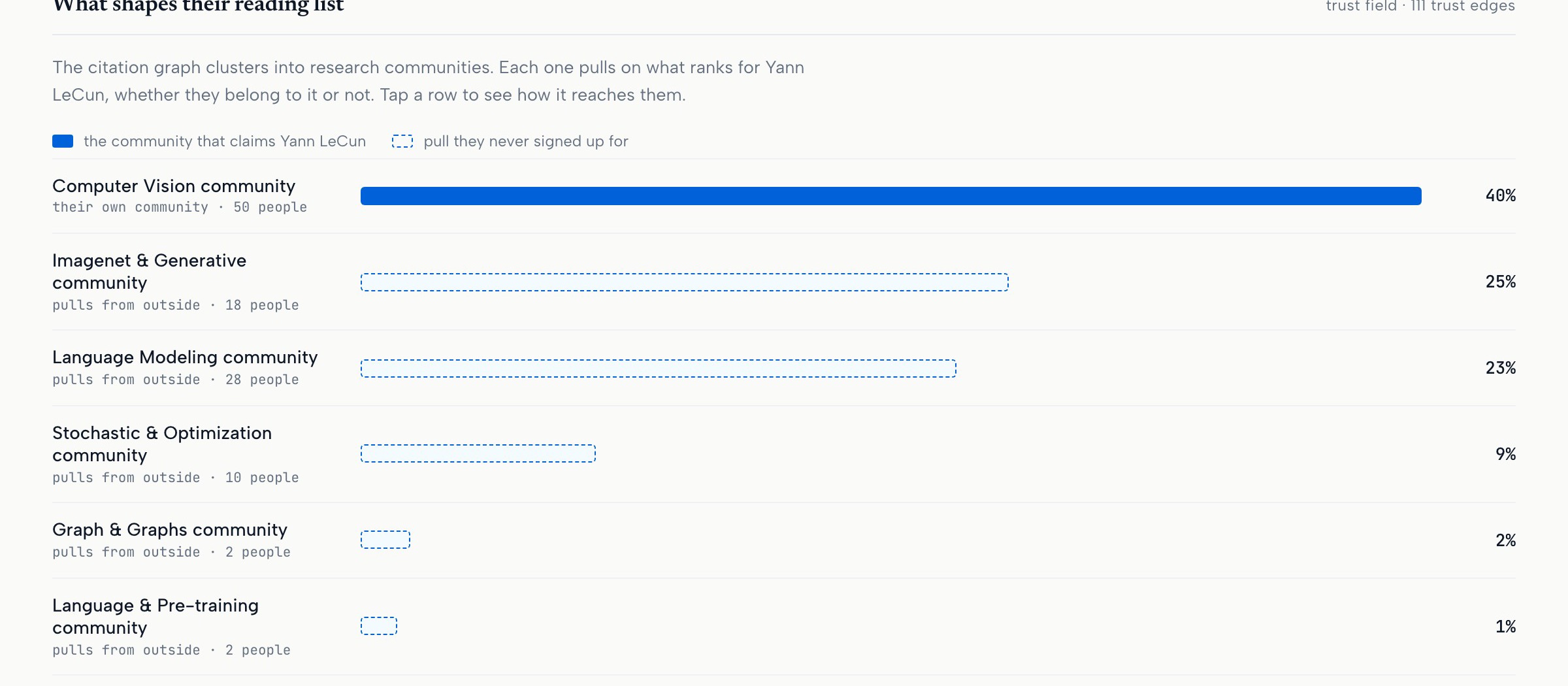
The engine also finds the communities in your graph and scores bridges: content that earns real endorsement from both sides of a disagreement. Engagement ranking splits a community to keep it clicking. Bridge scores give you the opposite lever, surfacing what holds it together. And the newest capability reads trust as a field. For any person it shows every community's pull on what they see, through which trusted people. "Why am I seeing this?" becomes a question you can actually answer.
Five live demos, one engine
Each demo runs the same engine over a different public record. Pick a viewer, see that person's ranking, then switch viewers and watch it reshuffle. Each one maps to a category you may already serve. Five so far. Any record of who endorses whom can be next.
For expert content and research libraries
science.uptrusthq.comResearch papers across the sciences, from the citation graph.
The same papers. A different reading list for every researcher.
858,000 papers, 434,000 researchers
For developer tools and code collaboration
git.uptrusthq.comOpen source repositories, from the star graph.
The same repos. A different top list for every developer.
35,000 repositories, 8,200 developers
For knowledge bases and reference content
wiki.uptrusthq.comEnglish Wikipedia, from the editor thanks log.
The encyclopedia anyone can edit, ranked by editors you'd actually trust.
235,000 articles, 8,900 editors
For review sites and local discovery
review.uptrusthq.comAn educational demonstration on the Yelp Open Dataset, with trust inferred from taste agreement.
A research demonstration of trust-weighted local discovery, not a product.
20,200 businesses, 22,900 reviewers
For social platforms and online communities
tpot.uptrusthq.comThe tpot Community Archive, posts from members who uploaded their own archives, with trust from likes and replies.
The same posts. A different timeline for every poster. Members can claim their node.
604,000 posts, 377 archives
Who can approve Kubernetes
Every organization keeps two records of authority: who holds it on paper, and who exercises it. Kubernetes publishes both. We measured eight months of public history, 165 repositories and 4,668 people who approved a pull request or authored an approved one, against the leadership roster and the permission files.
Held vs used
At release v1.30.0, seven people held approval rights over more than half of the core repository's directories, and one of them could single-handedly approve 98 percent of what merged. Covering half the core's approved work took four people; across the whole project, 25 to 28. Holding the right predicts neither heavy use nor light.
The roster is real signal
Most named tech leads really are top approvers. The chart is incomplete more than it is wrong.
Seated elsewhere
The busiest approver in most SIGs holds no seat in that SIG, yet nearly all of them hold one somewhere else. The chart misplaces people more than it misses them.
Every number reproduces from public records: the rankings with a single query, the permission figures with a published parser. The same comparison runs privately on your own systems: code review, document comments, ticket handoffs. Aggregate views first, governance controls from day one.
Read the full findingsRuns on data you already have
The engine reads the signals your platform already collects: follows, reviews, stars, purchases, thanks. You do not need to ask users to do anything new. The demos prove this. Each one was built from a public record that already existed, with no new input from anyone.
That means recommendation, discovery, and reputation that are personal and explainable, using the history you have on hand.
See how a trial works →Built for the agents that choose for people
AI agents are starting to shop, read, and decide on people's behalf. To do that well, they need a trust source that is personal and permissioned, not one global rating.
UpTrust runs a live server that speaks MCP. With a person's permission, granted through OAuth, an agent can rank options, check trust as a band, find trusted voices on a topic, find bridges (the voices both sides of a disagreement still trust), and suggest introductions, all from that specific person's point of view. It works with any MCP-aware agent.
What an agent can ask
Rank a set of options, check trust on a topic, find trusted voices, find bridges (the voices both sides of a disagreement still trust), and suggest introductions. Every answer comes from that specific person's perspective.
Permission is the product
The person grants access and can revoke it. Trust comes back as a band, never a raw score, so nothing about the underlying graph leaks out.
One server, many graphs
The social app and the science, git, wiki, and tpot graphs sit on one federated server as separate issuers. New graphs join the same way. It works with any MCP-aware agent.
"Find us a dinner spot for Friday."
An agent reading star averages picks the place with the best review farm. An agent reading your trust graph books the spot your food-obsessed friends keep going back to, and can say who.
"Pick a database library for this service."
Sorted by stars, the bot-inflated repo wins. Ranked through your graph, the winner is the one that developers you respect keep reaching for.
Common questions
What is UpTrust?
UpTrust builds a personalized trust engine. It reads who endorses whom and works out who trusts whom, and what should rank for each person. Our first product is a social platform built on it, and the same engine runs live over five public datasets.
How does trust-based ranking work?
Every endorsement, a follow, a citation, a star, a review, becomes evidence of trust or distrust between two people. Trust propagates: you inherit, at a discount, the trust of the people you trust. Whatever you look at is then ranked from your own point of view, weighted by who endorsed it, not how many. You might trust someone on climate science but not on economics. That nuance is the payoff: results match how you actually judge each subject. And because rank is viewer-relative, noise reaches you only through people you trust. It has no other way in.
Is UpTrust available now?
Yes. The social platform is live at uptrusting.com. The five demo graphs are public, and the MCP server is live for AI agents. For platform licensing, write to us below.
Can AI agents use it?
Yes. A live MCP server lets an agent query a person's trust graph with that person's permission. MCP is an open standard, so it works with any MCP-aware agent. The setup guide shows how to connect yours.
What does this look like for a marketplace or a gig platform?
A marketplace can rank sellers and products for each buyer, weighted by buyers whose judgment matches theirs, so review farms stop paying off. A ride or delivery platform can weigh each rating by who left it instead of averaging them all. Same engine, their data.
Can a company use it internally?
Yes. Code reviews, doc links, and thanks are endorsement records too. Point the engine at them and people find the answers, documents, and experts their own colleagues rely on, ranked for each asker. The field view shows how each team actually sees a proposal, a tool, or another team, not how the org chart says they should. And because standing is read from real acts all year, feedback and reviews start from evidence instead of recollection.
Won't personalized trust create echo chambers?
It runs the other way. The engine scores bridges, content endorsed by both sides of a disagreement, and the field view shows the pull of communities you never joined. An echo chamber hides the other side. This shows you exactly where it is and what it respects.
How does a trust enrichment trial work?
Start with one part of the data you already record. Hashed IDs, relationships and outcomes go into a clean room under your governance. The engine runs on your graph and returns trust features for each viewer and entity, with evidence and a band when evidence is thin. Test those features against your existing model on your own labels, then shadow live traffic before deciding to switch them on.
Start with a pilot on one data category
We begin with one part of your data, follows, reviews, stars, or purchases, and run the engine over it. You see personalized, explainable ranking on your own content before you commit to more. From there we scope how the layer fits your product.